Danielle E. Murray, JD 2007
South Royalton, VT 05068
New Castle County Courthouse
500 N. King Street, Suite 9425
Wilmington, DE 19801
Dear _________________,
Thank you for taking the time to read and consider my proposal to amend Title 10, Chapter 9, § 1041(2) of the Delaware Code. Please allow me to introduce myself and explain why amending the definition of “Domestic violence” will help to meet the Domestic Violence Coordinating Counsels (DVCC) mission to reduce domestic violence and abuse in all of its forms.
As a third year student at Vermont Law School, I elected to take a seminar class entitled Women and the Law, which focuses exclusively on Domestic Violence. As a native Delawarean I was curious to learn more about the various organizations and laws relating to domestic violence in the First State. I was impressed to learn Delaware was one of several states to receive funds from the Center for Disease Control to conduct DELTA programs, Senator Biden drafted the original Violence Against Women Act, and last year the DVCC passed all three of the bills proposed to the state legislature. However, Delaware is now among the minority of states that does not offer protection for victims of domestic abuse in a dating relationship.
Currently, thirty-six states provide protection orders for victims in a dating relationship, including neighboring states New Jersey and Pennsylvania. Over the past ten years, the coverage of domestic violence civil protection orders has increased and the number of states offering protection to members of a dating relationship has more than tripled. In Delaware, victims of domestic violence who do not meet the current statutory requirements are afforded limited remedies, which are often difficult and expensive to obtain. Amending the definition of “Domestic Violence” under Title 10, Chapter 9, § 1041(2), will protect a countless number domestic violence victims.
Accompanying this letter, I have attached various state statues, which allow protective orders for victims in dating relationships and a personal recommendation as to the most effective way for Delaware to amend the definition of “Domestic Violence.” If you have any questions regarding this issue, please do not hesitate to call or e-mail me. If possible, I would also be happy to send you additional research or meet with your organization in Delaware.
Thank you for your time and consideration. Good luck in the future.
Sincerely,
Danielle Murray
Saturday, March 31, 2007

Wednesday, March 14, 2007
Freedom

Reflection Project by Natasha Moodie, JD 2008
NB: One of our assignments was to complete a reflection project, which could be non-legal, personal reflections based on your interest in domestic violence issues. This project was intended to help tie together the domestic violence issues with our own personal development as a lawyer, and to reflect on those connections in a way to foster our personal and professional development.
NB: One of our assignments was to complete a reflection project, which could be non-legal, personal reflections based on your interest in domestic violence issues. This project was intended to help tie together the domestic violence issues with our own personal development as a lawyer, and to reflect on those connections in a way to foster our personal and professional development.
Monday, February 26, 2007
Facing Domestic Violence Head-on in the Workplace
Megan Campbell, JD 2007
Domestic violence is a problem that comes to work. In one study, seventy-four percent of individuals in abusive relationships reported that their abusers harassed them at work. http://www.aidv-usa.com/Statistics.htm Recently Vermonters were confronted by the reality of domestic violence in the workplace when Christopher Williams came into the Essex elementary school to find his ex-girlfriend. Domestic violence in the workplace is a problem Vermonters should not ignore. Luckily, there are constructive ways to address domestic violence before it becomes a problem in your workplace.
Employers and employees alike should ask themselves: Is my workplace adequately prepared to offer support to victims of domestic violence? Do we have appropriate security measures in place? Does my workplace provide an environment where victims of domestic violence feel comfortable communicating with their employers before the violence becomes a serious threat to employee safety? If the answer to any of those questions is “no”, consider implementing a domestic violence workplace policy.
Domestic violence policies prevent employers from discriminating against employees solely because of their status as a victim of domestic violence. These policies may also institute important workplace protections for domestic violence victims including:
- Improve workplace safety. Employers can develop safety plans with affected employees, enforce restraining orders, and review parking lot and building safety procedures to be sure that they are adequate.
- Recognize that domestic violence victims might have work performance problems. Affected employees should be provided flexible leave provisions that allow them to access needed counseling, medical or legal services.
- Provide health insurance coverage to employees that does not discriminate against domestic violence victims.
- Discipline or terminate employees who use work time and resources to abuse their partners.
If instituting a domestic violence policy seems daunting, take a look at other workplaces that have adopted them. These policies can serve as models for your workplace.
http://www.worklifealliance.org/policies/violence/index.cfm
http://www.cobar.org/group/display.cfm?GenID=3706
http://www.ag.state.la.us/violence/policy.htm
http://www.opdv.state.ny.us/workplace/statepolicy.html
http://mainegov-images.informe.org/ag/dynld/documents/DVPolicy.pdf
It may be tempting for some employers to address domestic violence in the workplace by firing employees who suffer abuse at the hands of a domestic partner. Discriminating against abuse victims is not the answer. If employers find pretexts to fire employees who are victims of domestic violence, women will work harder to hide the bruises, and to keep silent in order to keep their jobs. In rural communities women may be more hesitant to seek services if it could result in public disclosure. As a result, these women and their children will be more likely to remain in dangerous situations. Employers are also likely to lose valuable employees, or to remain unaware of safety concerns that could affect the workplace until it is too late.
Employers who take a stand against domestic violence are crucial. Without employer participation, domestic violence will continue to be a “private problem” that is not discussed at work until the violence becomes public. Facing domestic violence head-on in the workplace makes us all safer.
Other helpful websites that discuss domestic violence in the workplace include:
http://www.endabuse.org/programs/display.php3?DocID=75
This website gives good tips about how to have a discussion with an employee who might be facing dv at home.
http://www.abanet.org/domviol/workviolence.html
This website talks about steps employers need to take in addition to implementing a workplace policy.
http://www.opm.gov/employment_and_benefits/worklife/officialdocuments/handbooksguides/DomesticViolence_help/index.asp
http://www.legalmomentum.org/issues/vio/policies
Wednesday, February 14, 2007
Why We Stay
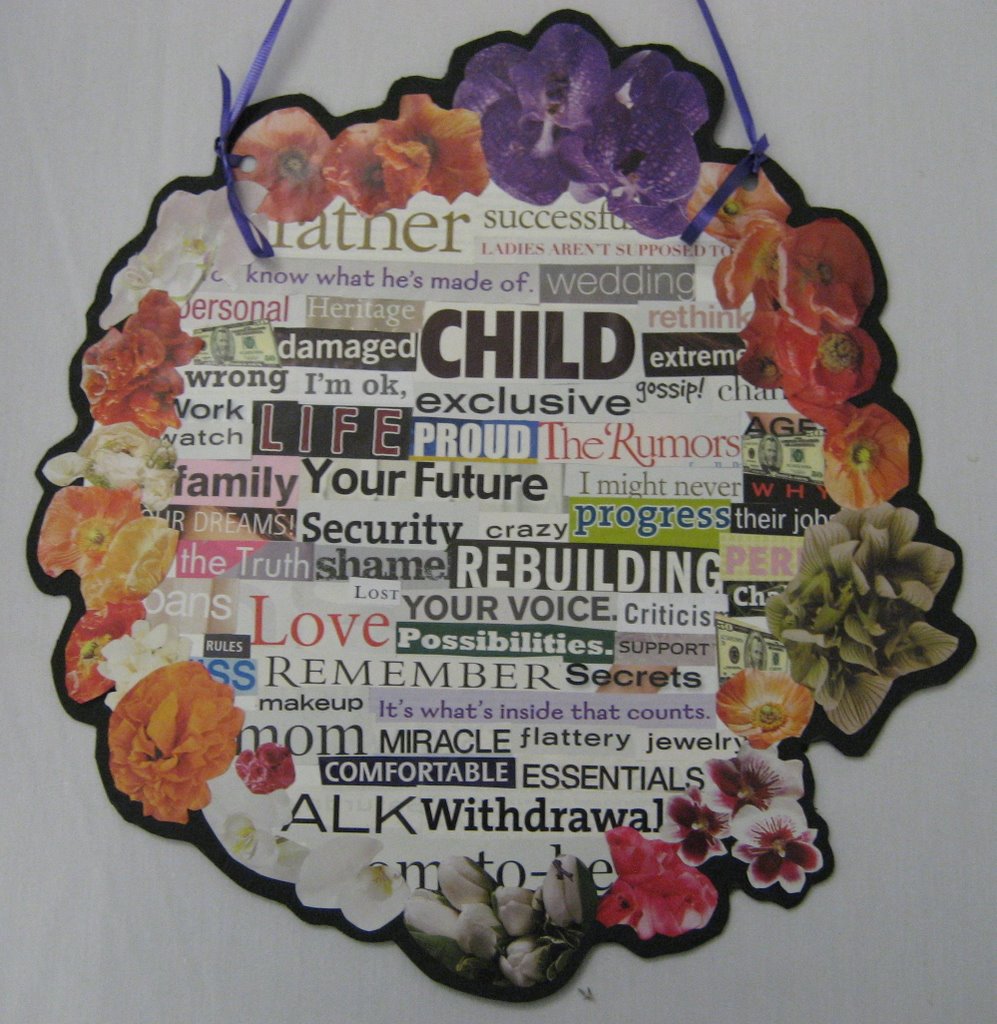
Why We Stay
This collage represents all the various reasons someone decides to stay in an abusive relationship. The phrases are surrounded by flowers, which depict the way a victim uses these excuses to justify and defend the abusive relationship, making the relationship seem perfect to friends and family.
-- Danielle Murray, JD 2007NB: One of our assignments was to complete a reflection project, which could be non-legal, personal reflections based on your interest in domestic violence issues. This project was intended to help tie together the domestic violence issues with our own personal development as a lawyer, and to reflect on those connections in a way to foster our personal and professional development.
Thursday, January 25, 2007
ABA Domestic Violence Writing Competition
The ABA Commission on Domestic Violence recognizes the vital role that rising lawyers play in the success of protecting and empowering those affected by domestic violence. In order to encourage and recognize law school students committed to ending domestic violence, the Commission launched an annual law student writing competition in 2004.
Two years ago, VLS student Judith Cutler received second place.
Deadline for submissions is Friday, March 30, 2007, 5:00 p.m. EST via email at runger@staff.abanet.org. See http://www.abanet.org/domviol/students.html for more information.
Two years ago, VLS student Judith Cutler received second place.
Deadline for submissions is Friday, March 30, 2007, 5:00 p.m. EST via email at runger@staff.abanet.org. See http://www.abanet.org/domviol/students.html for more information.
Sunday, January 14, 2007
Becoming One of “them”
Becoming one of “them”: Expanding our Definition of Domestic Violence
Meghan Clark JD 2008
When we hear the term “domestic violence,” what first comes to mind? A person may think of physical family disputes, hitting, punching, or kicking. But what about a verbal threat or a hand gesture intended to intimidate? Are we willing to go so far as to label these acts “domestic violence?” Maybe you are wondering why we should even care about this topic. Why bother? “Domestic violence couldn’t happen to me,” you think. That’s exactly what I used to say.
Five years ago, I began what gradually spiraled into an abusive relationship. It is only now that I am able to recognize this. I was a junior in college when it all started, and everything seemed perfect. He was attentive, sincere, and the perfect southern gentleman—for awhile. We were engaged, essentially living together, and even peacefully coexisting on many days.
I cannot point to that first argument, the moment when things changed, but one day I woke up, and I realized that I simply was not myself anymore. I no longer spent time with my friends. I was on edge all the time. I did everything I could to avoid making my partner upset. There was a lot of yelling, a lot of threats, and even more tears and apologies. There were no bruises. There was no hitting: a shove here and there, but never the kind of thing I had read about—and I definitely read a lot. As an undergraduate English major, the American Heritage Dictionary was like my “bible.” But nothing about my relationship fit into its definition of “domestic violence.” The American Heritage states that domestic violence is “violence toward or physical abuse of one’s spouse or domestic partner.” I knew that definition. I lived by my definitions. But that wasn’t my relationship, so I could continue to ignore it—could continue to deny the abuse.
Now, five years later, I have learned that many abusive relationships don’t fit this narrow definition. And American Heritage isn’t the only reference book that excludes relationships like mine. Merriam-Webster’s main entry for domestic violence includes only acts of physical violence between family or household members. Britannica Online slightly expands its definition to include any type of abuse between members of the same household. According to the state of Vermont, “abuse” involves physical violence between “family or household members” as well as “placing another in fear of imminent serious physical harm.” But what about the psychological and emotional “assault” that I lived with for years? If our publicly accessible reference materials aren’t dealing comprehensively with the term, how can we ever expect the average citizen to comprehend all that constitutes domestic violence?
So, again, why should you care? It takes years to change definitions and even longer to get the public to accept these newly defined terms. Such reform needs to happen, however. For women like me, it is easy to distance yourself from the problem if you don’t fit the definition. Women in relationships with “domestic violence” will always just be one of “them”—the others—until we expand our definitions. In any recovery program, you hear the mantra that admitting the problem is the first step. Similarly, the first step in combating domestic violence must be recognizing that your relationship fits into this definition.
It is not so much for legal reasons that I hope to expand the basic definition of domestic violence; it is for someone like me who needed to fit into a definition. From my own personal experiences and from my recent educational opportunities, I have learned that domestic violence does not begin with the first slap. Long before any physical altercations or threats of violence occur, many abusers envelop their partners in a web of emotional degradation and isolation; it’s about time our definition reflects this phenomenon.
To define everything that could constitute the earliest signs of domestic violence would take up a whole book by itself. This does not mean, however, that we cannot educate ourselves on the subject and begin to get at the problem from its root. In addition to passing laws to protect an abused partner once the bruises have already surfaced, if a man or a woman can identify himself or herself in a definition, maybe they will be able to seek the help that I didn’t even realize I needed. It may not be much, but if we take the small step to look at our reference materials and work to better define the very concept of “domestic violence,” then perhaps this is a good place to start in our campaign to put a stop to such an unfortunately common problem.
Wednesday, January 10, 2007
Protecting Children From Domestic Violence
Rebuttal Presumption Statute:
A Solution toward Protecting Children From Domestic Violence
Sharie Robinson, JD 2007
Domestic Violence is a destructive behavior that affects the entire family. We tend to focus primarily on the women who are encountering the physical and emotional abuse, but sometimes overlook the trauma children experience. To better protect the needs and interest of children, the Vermont Legislature should amend the “Best Interest of Child” statute to incorporate a Rebuttal Presumption against custody in Domestic Violence. This statute prevents individuals that abuse their spouses from obtaining custody of their children. The implementation of this statute is necessary to protect children witnessing their mother continued abuse; to keep them from developing emotional and behavior problems to prevent a cycle of violence from generation to generation.
Presently, there is an estimate of 3.3 million to 10 million children in the United States that are exposed to domestic violence each year. This exposure to domestic violence leads to many mental and physical disorders that can disrupt healthy development and prevent progress in school. Many children imitate these violent behaviors in future relationships and continue the cycle from generation to generation.
Thus, to help children grow and develop in a healthy and safe way, it is important to implement measures that will prevent children from being exposed to family violence.
Currently, Vermont utilizes the “best interest of the child” standard to handle divorce and child custody cases.
“…the court shall make an order concerning parental rights and responsibilities of any minor child of the parties. The court may order parental rights and responsibilities to be divided or shared between the parent on such terms and conditions as serve the best interest of the child. When the parents cannot agree to divide or share parental rights and responsibilities the court shall award parental rights and responsibilities primarily or solely to one parent…”
The "Best Interest of the Child" is a friendly statute that tries to meet the needs of the child by working with both parents to provide a healthy and stable environment. However, it is not effective in domestic violence cases. For example, if the judge orders joint custody for a couple that has had incidents of domestic violence, then the child remains at risk. In a joint custody arrangement, the abuser still has constant contact with the victim through the child. Additionally, the victim may be reluctant to allow the child to visit the other parent because of the potential abuse that could be afflicted upon the child as a result of the separation or divorce. Moreover, the victims’ compliance with the judges’ order puts the victim back into a continuous cycle of abuse, manipulation, and domination, which the state should be preventing as an overall objective. The current law is thus ineffective in protecting the child from further abuse and fails to prevent the victim from involvement with her abuser.
In domestic violence cases, the court must take domestic violence incidences into account in determining a child custody case. An abusive parent is not a fit parent because battering a child’s mother is equal to child abuse.
Solution: Rebuttal Presumption Against Custody in Domestic Violence
Implementing a statutory provision that has a rebuttal presumption against custody when domestic violence is present is an effective way to protect children. The presumption will not burden the victim with providing evidence of correlation between the wife abuse and child abuse from witnessing domestic violence. A presumption helps to prevent judges from awarding custody to an unfit parent who commits domestic violence. Moreover, a rebuttal presumption would help to cast a light on the continue abused that could follow if a judge grants joint custody. This statute is crucial in circumstances where judges are uneducated or biased on the issue of domestic violence and believe that the best interest of the child is to always have both parents involved in the child's life. Therefore, the Vermont legislature should act now to make our children lives safer and a future without family violence.
Subscribe to:
Posts (Atom)